
Which Types of Roofs Do Roofing Companies in Dallas, TX Recommend for an Older Home?
The situations described here are composites drawn from the types of jobs and decisions we encounter regularly. Names and specific figures are illustrative.
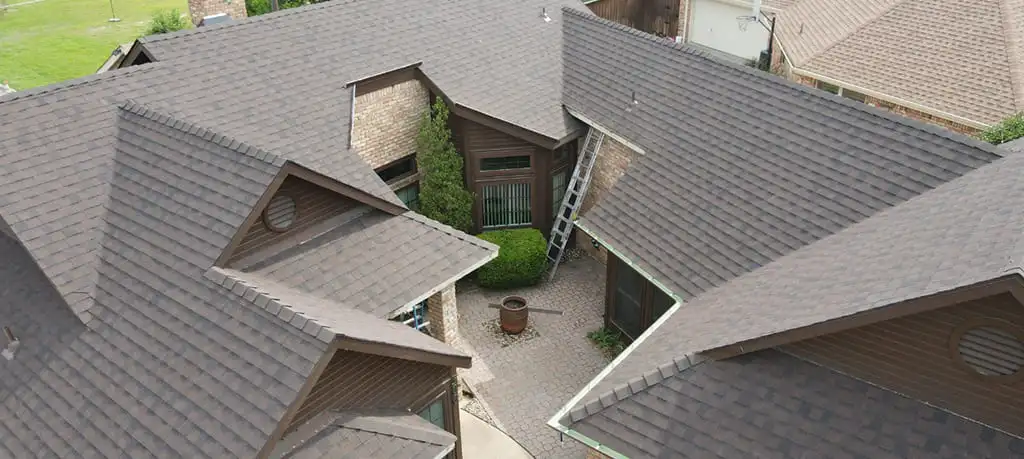
This is a story about choosing a roof type, and it is the kind of question roofing companies in Dallas, TX get every week. The house was a 1986 two-story brick home in Lake Highlands with a 21-year-old architectural shingle roof, about 32 squares, at a 6:12 pitch. There was also a rear patio cover, added later, at roughly 1.5:12, and it had been shingled to match. That patio ceiling had a water stain the size of a dinner plate. The owners planned to stay about ten more years. They had four quotes on the kitchen table for four different materials, and the prices ran from about $17,800 to $44,000. They wanted to know which one actually made sense for their house, not which one was best in general.
What the old roof was telling them
The main roof had done what most North Texas shingle roofs do. Granules were thin on the south and west slopes, a few tabs were creased from wind, and there were scattered soft spots from spring hail. Nothing had failed outright except the patio. Dallas sits in the state that leads the country in hail: Texas had 902 major hail events in 2025, counting stones an inch across or larger, more than twice as many as Kansas in second place[1]. A roof here gets tested more often than a roof almost anywhere else.
Age and heat matter too. InterNACHI’s life expectancy chart puts 3-tab asphalt at about 20 years and architectural asphalt at about 30, and it says plainly that hot climates drastically reduce asphalt shingle life[3]. A 2024 Dallas Morning News roundup of local roofers said most North Texas homes have architectural shingles, and that standard Class II shingles generally last only about 15 years under typical Dallas-area weather[4]. So a 21-year-old roof here was not a surprise replacement. It was overdue.
The four quotes, side by side
The quotes were not apples to apples, so the first thing we did was put them on one page. These are the job figures for this house, not market averages.
| Option | Quoted price | What came with it |
|---|---|---|
| Standard architectural shingle | $17,800 | Full tear-off, new underlayment, same style as the old roof |
| Class 4 impact-rated architectural shingle | $21,900 | Same scope, shingle tested to the highest impact class |
| Concrete tile | $38,000 plus a structural review | Heavier roof; framing would need to be checked first |
| Standing seam metal | $44,000 | New panels, trim and underlayment over the full main roof |
Every one of those quotes had shingles or tile going back on the patio cover, too. That was the first problem, and it had nothing to do with which material won on the main roof.
Why the patio cover could not stay shingled
The residential code sets a minimum slope for each roof type. Asphalt shingles are allowed only on slopes of 2:12 or steeper, clay and concrete tile need at least 2.5:12, metal shingles need 3:12, and slate needs 4:12[5]. A patio cover at 1.5:12 is below all of them. Water moves slowly on a slope that shallow, wind pushes it up under the shingle laps, and the stain on the ceiling was the result. Re-shingling it would have bought the same leak back.
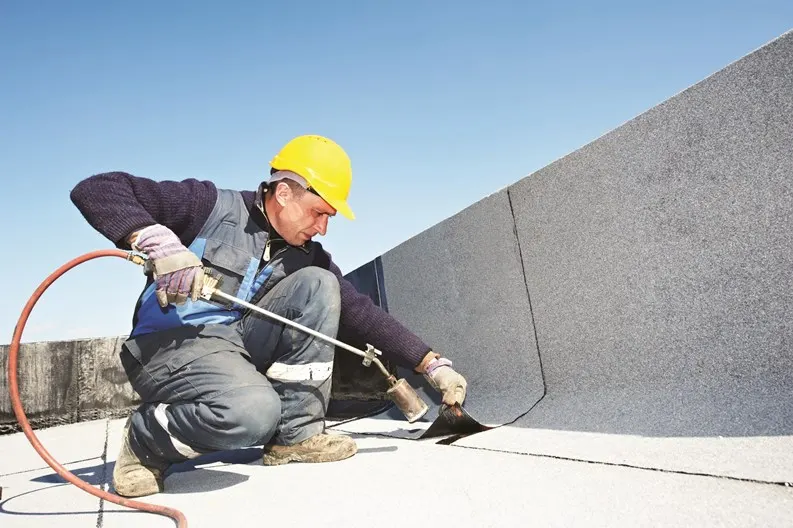
That section needed a low-slope system instead, a membrane made for roofs that are nearly flat. ENERGY STAR describes a low-slope roof as one at 2:12 or less and lists membranes and coatings among the common cool roof materials[6]. Choosing a light color made sense here. According to the Lawrence Berkeley National Lab figures that ENERGY STAR cites, a clean white roof that reflects 80 percent of sunlight runs about 50 degrees cooler on a summer afternoon than a gray roof that reflects 20 percent, and cool roofs save the most in hot, sunny places like the southern U.S.[6] On a patio cover that sits right outside the back windows, that difference is easy to feel. The low-slope work added about $2,400 to whichever main-roof option they picked.
Where tile and slate dropped out
The owners liked the look of tile. A few houses on their street had it. Tile lasts a long time; InterNACHI lists clay and concrete at 100 years or more[3]. The trouble was the house. It was framed for a shingle roof in 1986, and the local roofers in that Dallas Morning News piece noted that tile may need a specific lathing system to support its weight[4]. Before anyone could install it, the rafters and decking would need a structural review, and possibly reinforcement. That turned a $38,000 quote into an open-ended one. There was a second, quieter issue. The code does not allow a new roof to be laid over existing tile[5], so any future replacement means a full tear-off of a heavy roof. For a family staying ten years, they were paying for a lifespan that would mostly belong to the next owner.
Slate never really got started. InterNACHI gives it 60 to 150 years[3], it needs at least a 4:12 slope[5], and it carries the same weight questions as tile at a higher price. Real cedar shake came up once and went away just as fast because of the upkeep. If you want a deeper look at how different coverings hold up to sun and heat here, we covered that in our piece on UV-resistant roofing materials for Texas homes.
The real decision: metal or Class 4 shingles
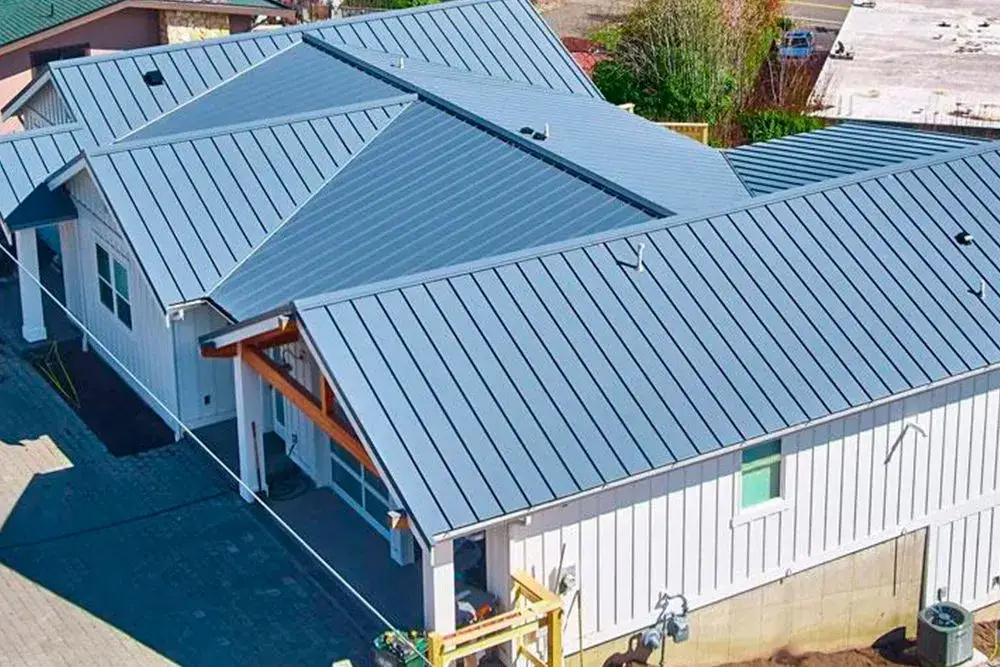
That left two serious options. Standing seam metal has the longest life of the two by a wide margin; InterNACHI lists metal roofing at 40 to 80 years[3]. It also has no granules to wear off. The owners’ worry was hail. A local roofer in that same Dallas Morning News piece noted that metal can be dimpled by a bad storm and lose its looks[4]. Dents are cosmetic, but they show from the street. The bigger issue was price. At $44,000, metal cost about twice the Class 4 shingle quote. We walk through more of that tradeoff on our metal roof installation page and in a longer metal roof decision guide for North Texas homeowners.
Class 4 refers to impact testing. The Texas Department of Insurance explains that roofing materials are lab-tested for impact resistance and rated Class 1 through 4, and that a Class 4 roof covering earns the highest premium credit[2]. The Dallas Morning News roofers put Class 4 shingles at about 30 percent more than standard shingles[4]. On this house the gap was $4,100. The open question was what that $4,100 would earn back.
“Texas leaves it to each insurance company to set the discount for an impact-rated roof, and to decide what paperwork it wants.[2] The same Class 4 shingle can be worth a lot on one policy and very little on another.”
Don Scott, Co-Founder, Fireman’s Roofing
That call is the step most people skip. TDI says the discount amount for each class is set company by company, and each insurer decides which test standards it accepts, how the product must be labeled, and what forms the contractor and policyholder have to send in[2]. For policies through the Texas Windstorm Insurance Association, the shingle has to pass UL 2218, be labeled with its class, and the contractor fills out TDI form PC068 after installation; other insurers may use that form or their own[2]. The owners’ carrier quoted them a discount on the wind and hail portion of the premium that, over ten years, would cover most of the $4,100 difference. Their neighbor’s carrier offered far less. The same roof can pencil out differently on the same street.
| Factor | Class 4 shingle | Standing seam metal |
|---|---|---|
| Installed price on this house | $21,900 | $44,000 |
| Listed life expectancy | About 30 years for architectural asphalt[3] | 40 to 80 years[3] |
| How hail shows up | Bruising or granule loss in a bad storm | Possible cosmetic dents |
| Fit for a ten-year stay | Close to the full value used | Much of the value left for the next owner |
What people usually ask at this point
Most homeowners ask whether Class 4 means the roof cannot be damaged. It does not. It means the shingle passed the highest level of a standard impact test[2]. That is a test rating, not a guarantee, and the roof still deserves a look after a big storm. The second question is usually whether they can put the new roof over the old one to save money. Sometimes the code allows one layer over another, but not over tile, not over a roof that already has two layers, and not over a roof that is water-soaked or too deteriorated to be a good base[5]. On this house the old shingles came off regardless, because the decking needed to be checked.
The third question is whether the color matters on a shingle roof. It does a little. ENERGY STAR notes that lighter-colored roofs stay cooler than roofs that absorb sunlight[6]. On this house they kept a mid-tone gray to match the brick and put their attention on attic ventilation instead.
What they chose and how it went
They went with Class 4 architectural shingles on the main roof and a white low-slope membrane on the patio cover, for a total of $24,300. The job was booked for late October, after the spring storm backlog had cleared. Tear-off showed four sheets of soft decking near the back valley, which were replaced at the per-sheet price in the contract. The patio ceiling was repaired once the membrane had been through two rains without a drip. We gave them the product labels and the installation paperwork for their carrier, and the discount showed up on the next renewal notice.
They did give something up. In 20 years, if they are still there, they will probably be pricing a roof again, and a metal roof would not have needed that. They knew that going in. For a ten-year horizon, it was the tradeoff that made sense. The details of what a full tear-off includes are on our roof replacement page.
What another homeowner can take from this
There is no single best roof type in Dallas. The pitch of each section, what the framing was built to carry, how long you plan to own the house, and what your own insurer will credit are what decide it. If part of your roof is close to flat, it probably needs a different material from the rest. If you plan to stay 25 years, metal starts to look different than it did here. If you are leaving in five, a standard shingle may be the honest answer. Most roofing companies in Dallas, TX can walk a roof and give you those facts before you sign anything, and a free roof inspection with photos is a reasonable place to start.
If you are weighing materials for your own house, you can find more on our residential roofing services in North Texas here.
Sources
- Facts + Statistics: Hail, Insurance Information Institute (Triple-I), citing NOAA Storm Prediction Center data, 2026
- Products qualifying for impact-resistant roofing credits, Texas Department of Insurance
- Standard Estimated Life Expectancy Chart for Homes, International Association of Certified Home Inspectors (InterNACHI)
- North Texas roofing pros weigh in on the best types of roofs, and how to make them last, The Dallas Morning News, January 19, 2024
- 2021 International Residential Code, Chapter 9: Roof Assemblies (Sections R905 and R908), International Code Council, via UpCodes
- Cool Roofs, ENERGY STAR, U.S. Environmental Protection Agency

Aute mi ut suspendisse velit leo, vel risus ac. Amet dui dignissim fermentum malesuada auctor volutpat, vestibulum ipsum nulla.
Sed reprehenderit quam, non felis, erat cum a, gravida lorem a. Ultricies in pellentesque ipsum arcu ipsum ridiculus velit magna, ut a elit est. Ultricies metus arcu sed massa. Massa suspendisse lorem turpis ac.
Massa suspendisse lorem turpis ac. Pellentesque volutpat faucibus pellentesque velit in, leo odio molestie, magnis vitae condimentum.